

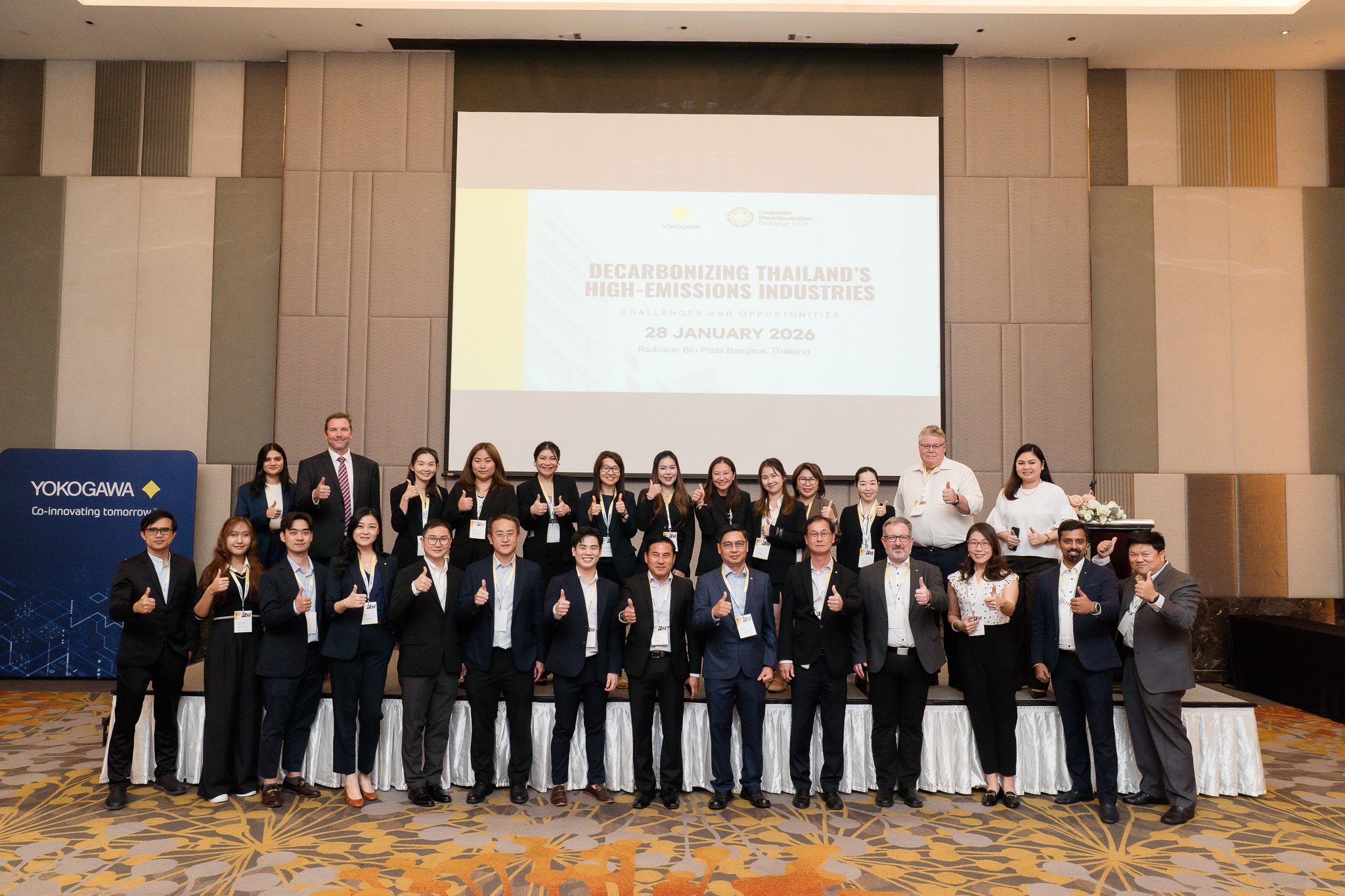
Bangkok, Thailand – 28 January 2026 – With the European Union’s Carbon Border Adjustment Mechanism (CBAM)’s shift from a reporting phase to full paid compliance on 1 January 2026, Thai businesses that rely heavily on trade with the bloc, including for cement, iron & steel, and aluminum, are now viewing decarbonization as an imperative to unlock market competitiveness.
Under the new carbon levy, importers will be required to buy and surrender CBAM certificates based on the embedded emissions in those products, with prices linked to the EU Emissions Trading System (EU ETS).
The EU remains a critical export destination for Thailand, accounting for roughly 10% of total exports in 2022. An estimated 1.49% of Thai exports to the EU, particularly iron and steel, are expected to fall under the new carbon pricing framework.
Against this backdrop, Japanese automation and tech firm, Yokogawa, and decarbonization platform Southeast Asia Corporate Decarbonization Exchange (CDx) convened senior leaders from industry, finance, and policy in Bangkok for a forum titled Decarbonizing Thailand’s High-Emissions Industries: Challenges and Opportunities.
Preliminary assessments suggest CBAM could result in annual revenue losses of approximately US$500 million, equivalent to about 0.2% of Thailand’s GDP. While the overall macroeconomic impact is manageable, the mechanism introduces significant transition risks for export-oriented industries that underpin Thailand’s manufacturing competitiveness.
Industrial decarbonization shifts from climate agenda to competitiveness strategy
Opening the forum, CDx Chief Executive Officer Mark Lister underscored the economic stakes of the transition.
“Decarbonization is no longer only about climate targets, it is about economic and industry competitiveness in a changing world,” Lister said. “Companies recognize the imperative to act, but many still face a fragmented landscape of technologies, finance, and regulatory signals.”
The forum highlighted how global trade measures such as CBAM, alongside investor scrutiny and supply chain transparency requirements, are transforming carbon performance into a commercial variable.
Industries including petrochemicals, chemicals, cement and steel, core to Thailand’s export economy, are now navigating simultaneous pressures from buyers, regulators, and capital markets.
Climate transition is fundamentally an energy and systems challenge
Michael Williamson, Section Chief, Energy Division, United Nations Economic and Social Commission for Asia and the Pacific (UNESCAP), emphasized that industrial decarbonization must be understood within broader structural shifts in the energy system.
“Climate change is often placed in the environmental box, but in reality it affects economies and societies just as deeply,” Williamson said. “In Asia-Pacific, around 72 per cent of emissions are energy-related, which means industrial transformation sits at the centre of the solution.”
He noted that while technologies already exist, implementation remains uneven.
“The technologies and finance largely exist, but what is required now is unprecedented cooperation and trust across sectors and countries.”
Williamson also pointed to energy efficiency as the most immediate opportunity.
“Energy efficiency remains one of the most powerful but underutilised levers for industrial decarbonisation.”
Meaningful climate action requires both strategic intent and operational execution and this transformation must begin where emissions are created. Vachan Alva, Head of Power, Renewable & Water at Yokogawa Engineering Asia, added “as climate transition primarily begins on the plant floor, decarbonisation starts with visibility and control. Yokogawa enables this and supports customers through our consultative approach and our well-integrated measurement, automation, and digital solutions that allow hard-to-abate industries to monitor emissions, optimize energy use, and execute their climate transition with confidence.”
Execution gaps, not ambition, are emerging as the main bottleneck
Across panel discussions, speakers repeatedly highlighted a structural gap between climate commitments and operational implementation.
Wachirachai Koonamwattana, Chief Sustainability Officer, The Siam Cement PCL (SCG), noted that awareness across industry has increased significantly, but execution remains complex.
“There is already strong awareness across industry, but execution is the key challenge,” he said. “Progress depends heavily on collaboration within companies, across industries, and with the government.”
He explained that companies increasingly need structured roadmaps that combine near-term efficiency improvements with longer-term technology pathways such as carbon capture.
“Many solutions are already economically viable today. The challenge is prioritization and coordination.”
The growing pressure for verifiable emissions performance highlights the critical need for partners who can translate decarbonization targets into operational reality. This is precisely where Yokogawa creates value by turning sustainability ambitions into measurable, plant-level actions and transformations.
Alicia Hui, Head of Digital Enterprise Solutions at Yokogawa Engineering Asia, emphasized “many industrial companies already have clear decarbonization ambitions, but the gap often lies between strategy and implementation. Closing this gap requires connecting sustainability goals directly with plant operations through data, automation, and optimization so that emissions reduction becomes part of everyday decision-making.”
Incremental solutions gaining momentum alongside long-term technologies
Christopher Best, Private Sector Infrastructure specialist, Asian Development Bank, highlighted the importance of practical, near-term solutions.
“There is a tendency to focus only on transformative technologies, but there are many incremental opportunities available right now,” Best said. “Companies should not let the perfect become the enemy of the good.”
Dr. Uma Wirutskulshai, National Project Coordinator, United Nations Industrial Development Organization (UNIDO) noted that market dynamics are reshaping corporate incentives.
“Decarbonization is no longer just about saving costs, it is increasingly a license to operate,” she said. “Companies that cannot demonstrate emissions performance risk losing access to markets.”
Demand-side mechanisms, including green public procurement and supply chain disclosure requirements, were identified as critical accelerators.
Financing available but project pipelines remain limited
Despite growing interest from investors, speakers highlighted a persistent disconnect between capital availability and bankable projects.
“Before bankability, there needs to be relationship building and open collaboration between financiers and industry,” Best said. “The willingness to fund exists, but projects must be structured and brought forward.”
Participants noted that aligning engineering data, emissions baselines, and investment frameworks early in project design is essential.
Throughout the discussions, one operational theme consistently surfaced: measurement and integration.
Yokogawa representatives emphasized that digitalization and advanced control systems are becoming foundational to industrial transition strategies.
“Industrial decarbonization must be embedded into daily operations,” said Preechai Trannitad, Managing Director of Yokogawa Thailand. “Through measurement, automation, and energy optimization, sustainability ambition can be translated into real operational outcome. Backed by our deeply rooted automation expertise and strong R&D capabilities, we co-innovate with customers to develop and deploy frontier technologies that future-proof their operations, enhance resilience, and accelerate the transition toward the net-zero goal.”
Examples presented during the forum showed how advanced process control and real-time optimization can deliver measurable emissions and cost reductions.
From ambition to implementation
As global trade rules evolve and carbon transparency becomes embedded across supply chains, Thailand’s industrial transition is entering a new phase.
Near-term priorities identified at the forum include:
- Strengthening emissions and energy data architecture as a foundation for decision‑making
- Scaling energy efficiency investments as the fastest and most cost‑effective decarbonization lever
- Aligning engineering, operations, and finance to accelerate bankable project development
- Preparing for CBAM and other carbon‑linked trade compliance mechanisms
- Accelerating cross‑sector collaboration to reduce execution risk and duplication of effort
The forum concluded that competitiveness in a carbon-constrained economy will increasingly depend not on targets, but on execution capability.
“Guided by Yokogawa’s Three Sustainability Goals for 2050 and anchored by their Trusted Green principles, Yokogawa supports customers to turn decarbonization commitments into measurable, plant‑level outcomes. Leveraging our deep industry expertise in high‑emission sectors, including Chemicals, Iron & Steel, Cement, Pulp & Paper, and Metals & Mining, we help future-proof businesses in Thailand and across our global footprint to achieve tangible energy savings, emissions reduction, and more sustainable operational performance for a greener future.” says Joshua Kyaw Zwa, Head of Materials Business at Yokogawa Engineering Asia.
Yokogawa and CDx reaffirmed their commitment to supporting Thailand’s industrial transition through integrated solutions connecting partnerships across measurement, control, optimization, and finance by enabling this shift from ambition to implementation.